
|
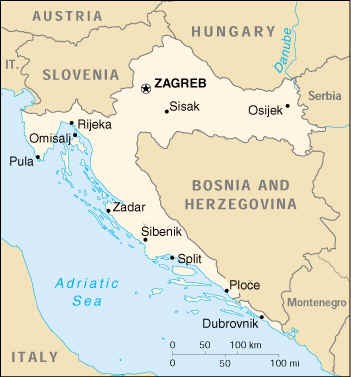
Republic of Croatia is geographically considered as central European and Adriatic country. It is placed in the hart of Europe, touching Mediterranean, Panonian and Dinarian and Pre-alpic regions, and it is also located in the area which was culturally influenced by Romans, Hungarians and Germans. In its size it is similar to that of Denmark, Holland, Switzerland or Ireland, while population is similar to that of Finland, Denmark or Norway. |
|
Even though it might look like it is hilly and mountainous, Croatia does not have any peaks that are above 1900m above the sea level. Roughly 53% of its area is lower than 200m, which are mostly found in the eastern and northern parts of Croatia, low lying shoreline is limited to the narrow coastal zone, while coastal plains are more extensive only in Istria, Ravni Kotari and around lower banks of river Neretva.
The
Adriatic coast in Croatia is one of the most indented in the world, having
some1778km of the shoreline; Croatia also has 1185 islands, reefs and
spurs which make the coastal line of some 4057km.
Climate in the coastal region and islands is Mediterranean (mild and wet
winters, hot, dry and sunny summers); in Zagora sub-Mediterranean (somewhat
cooler winters and hotter summers). Inland climate is moderate continental,
wetter in the west and dryer in the east.
Adriatic Sea is and extraordinary natural phenomenon and it plays a major role in the economic development of Croatia. Exit to the open and warm sea in the vicinity of central European countries gives Croatia array of logistic, geographic and economic advantages.
Croatia has a very rich and diverse flora and fauna. Today 1/3 of its area is covered in forests, even though a lot of land has been cleared and cultivated, while in the coastal regions rocky pastures, coastal shrubs and limestone formations are a very common sight.
Man
planted pine forests have a significant importance for tourism in the
coastal regions.
Roughly
half of the population of our Republic leave in urban areas, the
biggest cities being capital Zagreb, harbours Split and Rijeka, and
a Panonia plane centre Osijek, all with population of above
100, 000.
Versatile food and chemical industry, agriculture (grain and industrial crops in continental part of the Republic, Mediterranean culture and seasonal fruit and vegetables on the coast), considerable potential in livestock and fishing, navigation and commerce, well established ship building industry and tourism, including a very convenient geographical position are base for future economic growth of Croatia.


